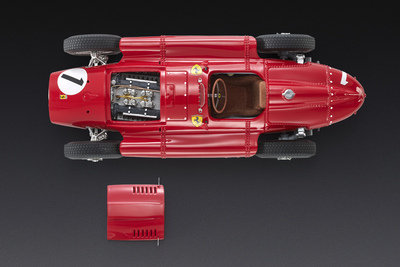
The Ferrari Lancia D50 was a Formula One racing car designed by Vittorio Jano for the Scuderia Lancia team in the 1954 Formula One season. The car was later taken over by Ferrari after Lancia withdrew from racing in 1955. The D50 was notable for its innovative design, featuring a V8 engine mounted in the rear of the car, which was a departure from the front-engined cars that were common at the time.
The #1 Ferrari Lancia D50 driven by legendary Argentine driver Juan Manuel Fangio won the British Grand Prix in 1956. Fangio was a five-time Formula One World Champion and is considered one of the greatest drivers in the history of the sport.
One of the unique features of the Ferrari Lancia D50 #1 driven by Fangio was its openable parts. This allowed the mechanics to access the engine and other components more easily during pit stops or for maintenance. This innovation helped the Ferrari team to make quick adjustments and repairs, giving them an edge over their competitors.
Overall, the Ferrari Lancia D50 was a groundbreaking car that helped to push the boundaries of Formula One technology and performance. The victory at the British Grand Prix in 1956 was a testament to the skill of Juan Manuel Fangio and the engineering excellence of the Ferrari team.
1:43 | Racing | GP Replicas
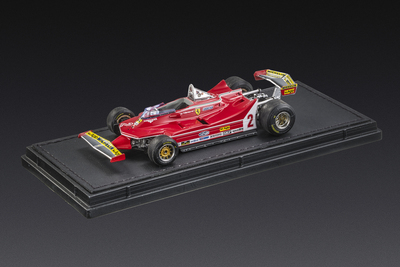
The Ferrari 312 T5 was a Formula One car built by Scuderia Ferrari for the 1980 Formula One season. It was designed by Mauro Forghieri and introduced as an evolution of the previous year's 312 T4 model.
The 312 T5 featured a lightweight aluminum monocoque chassis and was powered by a 3.0-liter flat-12 engine that produced around 515 horsepower. The car also featured a 5-speed manual gearbox and a rear-mounted radiator to improve aerodynamics.
The 1980 season was a challenging one for Ferrari, as they struggled to keep up with the dominant Williams and Brabham teams. The 312 T5 proved to be unreliable and lacked the performance needed to compete at the front of the grid. Despite this, the car did manage to secure a few podium finishes throughout the season.
The drivers for the 1980 season were Jody Scheckter and Gilles Villeneuve. Scheckter retired from Formula One at the end of the season, while Villeneuve continued with Ferrari until his tragic death in 1982.
Overall, the Ferrari 312 T5 was not a successful car and is often considered one of the least competitive models in Ferrari's history. However, it still holds a place in the hearts of Ferrari fans as a symbol of the team's perseverance and dedication to success.
1:43 | Racing | GP Replicas
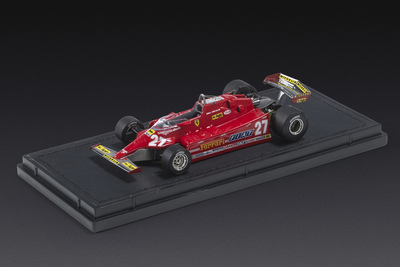
The Ferrari 126 CX Villeneuve was a Formula 1 racing car designed and built by Ferrari for the 1981 Formula 1 season. It was named after the legendary Canadian driver Gilles Villeneuve, who had tragically died during the previous season.
The 126 CX was designed by Mauro Forghieri and Harvey Postlethwaite and featured a turbocharged 1.5-liter V6 engine, which was a departure from Ferrari's traditional naturally aspirated engines. The car also featured a ground-effect aerodynamic design, which improved its handling and performance on the track.
The 126 CX made its debut at the 1981 United States Grand Prix West, with drivers Gilles Villeneuve and Didier Pironi behind the wheel. The car showed great promise, with Villeneuve scoring pole position in its first race.
Throughout the season, the 126 CX showed competitive pace, with Villeneuve and Pironi scoring several podium finishes. However, reliability issues plagued the car, and it struggled to compete with the dominant Williams and Brabham teams.
Despite its shortcomings, the Ferrari 126 CX Villeneuve remains a fan favorite for its striking red livery and the legacy of Gilles Villeneuve. The car's turbocharged engine and ground-effect design also set the stage for Ferrari's future success in Formula 1.
Overall, the Ferrari 126 CX Villeneuve was a significant car in Ferrari's racing history, and it is remembered as a symbol of the team's determination and spirit during a challenging season.
1:43 | Racing | GP Replicas
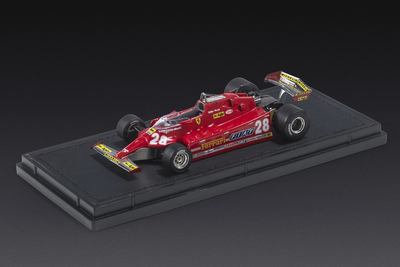
The Ferrari 126 CX Pironi, also known as the Ferrari 126 C2, was a Formula One racing car designed by Ferrari for the 1982 Formula One season. It was named after the driver Didier Pironi, who tragically lost his life in a boating accident in 1987.
The 126 CX Pironi was an evolution of the previous year's Ferrari 126 C model, with several improvements and modifications to make it more competitive. The car featured a monocoque chassis made of carbon fiber and aluminum honeycomb, which provided a good balance of rigidity and lightweight construction.
The 126 CX Pironi was powered by a 1.5-liter turbocharged V6 engine, which produced around 600 horsepower in race trim. This engine was mated to a 5-speed manual gearbox, which provided quick and precise shifts for the drivers.
The car was driven by a talented lineup of drivers, including Patrick Tambay, Mario Andretti, and Rene Arnoux. Despite the strong performances of the drivers, the 126 CX Pironi struggled to match the pace of its competitors, such as the dominant Williams FW08 and McLaren MP4/1.
The 1982 season was a challenging one for Ferrari, with the team failing to win a race and finishing a disappointing fifth in the Constructors' Championship. However, the 126 CX Pironi did show flashes of speed and competitiveness, with Patrick Tambay scoring two podium finishes in the car.
Overall, the Ferrari 126 CX Pironi was a solid but ultimately unsuccessful Formula One car. Despite its shortcomings, it remains a significant part of Ferrari's racing history and is remembered fondly by fans of the sport.