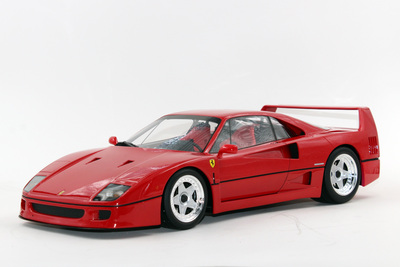
The Ferrari F40 is a high-performance sports car produced by the Italian automaker Ferrari from 1987 to 1992. It was designed to celebrate Ferrari's 40th anniversary and was the last car to be personally approved by Enzo Ferrari before his death.
The F40 is powered by a 2.9-liter twin-turbocharged V8 engine that produces 471 horsepower and 426 lb-ft of torque. It has a top speed of 201 mph and can accelerate from 0 to 60 mph in just 3.8 seconds.
The body of the F40 is made of carbon fiber and Kevlar, making it extremely lightweight and aerodynamic. It features a distinctive low-slung design with large rear wing and pop-up headlights.
Only 1,315 Ferrari F40s were ever produced, making it a highly sought-after collector's car. It is considered one of the greatest supercars of all time and is often regarded as a benchmark for performance and design.
The Ferrari F40 has been featured in numerous movies, television shows, and video games, further cementing its iconic status in automotive history. It remains a symbol of Ferrari's commitment to pushing the boundaries of performance and technology.
1:18 | Racing | GP Replicas
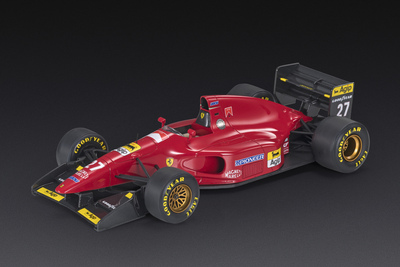
The Ferrari 412 T1 was a Formula One car designed and built by Scuderia Ferrari for the 1994 Formula One World Championship. The car was driven by French driver Jean Alesi and Austrian driver Gerhard Berger.
The Ferrari 412 T1 was powered by a 3.5-liter V12 engine and featured a semi-automatic gearbox. The car had a distinctive and aggressive design, with a low nose and high rear wing. The 412 T1 was also equipped with active suspension, a technology that was controversial at the time.
Jean Alesi had a strong season with the Ferrari 412 T1, scoring podium finishes at the Spanish, Canadian, and Hungarian Grands Prix. However, he was unable to secure a race win during the season. Gerhard Berger also had a competitive season, finishing on the podium at the German and Portuguese Grands Prix.
The Ferrari 412 T1 was ultimately not as successful as the dominant Williams FW16, driven by Alesi's former teammate, Damon Hill. Despite this, the car was considered competitive and reliable, with both drivers consistently scoring points throughout the season.
Overall, the Ferrari 412 T1 was a solid performer in the 1994 Formula One season, but it was unable to match the pace of the Williams cars. It was replaced by the Ferrari 412 T1B for the 1995 season.
1:18 | Racing | GP Replicas
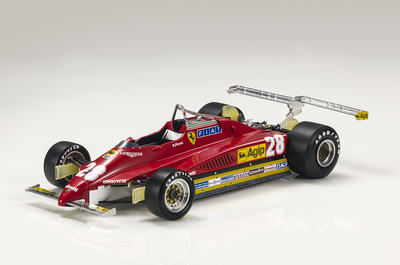
The Ferrari 126 C2 Long Beach Pironi was a Formula 1 racing car designed and built by Scuderia Ferrari for the 1982 Formula One season. It was driven by French driver Didier Pironi.
The car was an evolution of the Ferrari 126 C2, which had been introduced the previous year. The 126 C2 Long Beach Pironi featured a new aerodynamic package and suspension setup designed to improve performance and handling.
The car made its debut at the 1982 United States Grand Prix West in Long Beach, California. Pironi qualified in 5th place and finished the race in 2nd, behind Nelson Piquet in the Brabham BT49.
Throughout the 1982 season, Pironi and the Ferrari 126 C2 Long Beach Pironi showed strong performance, with Pironi finishing on the podium multiple times. However, tragedy struck at the German Grand Prix at Hockenheim when Pironi was involved in a horrific crash that ended his racing career.
Despite the setback, the Ferrari 126 C2 Long Beach Pironi continued to be competitive for the remainder of the season, with Pironi's teammate Patrick Tambay scoring a victory at the German Grand Prix.
Overall, the Ferrari 126 C2 Long Beach Pironi was a successful racing car that showcased Ferrari's engineering prowess and competitiveness in Formula 1.
1:18 | Racing | GP Replicas
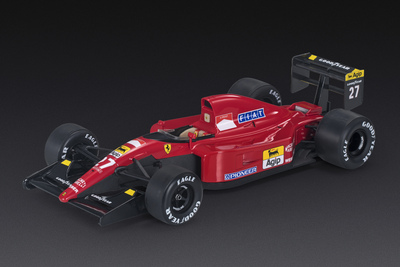
The Ferrari 643 was a Formula One car designed by Ferrari for the 1991 season. It was driven by French driver Alain Prost, who raced under the number 27. The car was designed by Steve Nichols and Jean-Claude Migeot and featured a semi-automatic gearbox and a 3.5L V12 engine.
The Ferrari 643 had a difficult season, with Prost struggling to match the pace of the front-runners. The car suffered from reliability issues and Prost only managed to secure two podium finishes throughout the season. Despite this, Prost was able to finish in 5th place in the Drivers' Championship.
The Ferrari 643 was not considered to be one of Ferrari's most successful cars, but it did lay the foundation for future successes. The car was replaced by the Ferrari 642 for the 1992 season.
Overall, the Ferrari 643 was a competitive car that struggled with reliability issues and failed to live up to expectations. Alain Prost's talent behind the wheel helped to salvage some respectable results, but ultimately the car was not able to challenge for the championship.